


A place to start
- Find an online or local group with an official contact or registration page.
- Check who can join and how you can participate, including diagnosis and communication requirements.
- Ask what the first meeting involves before deciding whether to attend.
You can adapt the messages below, send them in writing, or ask someone you trust to help you contact an organizer.
What Are Autism Support Groups for Adults?
Autism support groups for adults bring autistic people together to share experiences, ask questions, and exchange practical support. Some are led by autistic peers; others have staff facilitators. Their membership rules, discussion topics, and ways of participating vary.
You might want to talk about a recent diagnosis, compare ways of managing a noisy workplace, or meet people who understand why an unexpected change can take effort. You may also want company without discussing personal difficulties. Look at what the group actually does.
Swipe across the table to see all columns.
| Type | What you might do | What to check |
|---|---|---|
| Peer support | Discuss experiences and exchange suggestions with people who share relevant lived experience. | Who facilitates, how discussion works, and whether the topics fit your needs. |
| Social or interest group | Play games, make art, walk, or spend time together around an activity. | The activity, pace, sensory setting, and expected amount of conversation. |
| Group therapy | Work toward clinical goals with an appropriately qualified professional. | The clinician’s qualifications, treatment approach, eligibility, and fees or insurance. |
A facilitator may be a clinician without providing therapy in that particular role. AANE’s support group guidance makes its own boundary clear: AANE support groups are not intended to be therapy.
A systematic review published online in 2025 examined 15 articles about 12 peer-support programs for autistic adolescents and adults. Participants often valued connecting through shared experiences. None of the included studies had a control group, so the findings cannot establish how effective support groups are overall.
Where to Find Adult Autism Groups
The resources below include providers in the US, UK, Australia, and Canada. Country labels show where a provider is based; they do not mean every resident can join. Some online groups accept people from other countries, while others have local residency rules.
Read the page for the specific event before registering. Check its time zone and the date where you live, as well as whether the session is for autistic adults, partners, or parents.
Official resource pages checked November 12, 2026. This confirms the published information and contact routes, not a place at a particular meeting.
Swipe across the table to see all columns.
| Resource and location | What it offers | Before you join |
|---|---|---|
| AANEUS-based · online | Online support groups organized by age and identity. Its free Community Connections sessions provide a 60-minute introduction to the group experience. | Most single-session groups cost US$10; some are free. Series cost US$100 to US$180. Financial assistance is available. Register in advance. Events marked LOCAL have regional restrictions; other events are available from any location. |
| Autism On the GoUS-based · online | Free, autistic-led online groups, including support discussions, creative activities, and parallel play. | No diagnosis is required. Cameras, microphones, and chat are optional. Register at least 24 hours ahead. Check each group’s audience and current schedule. |
| GRASPUS-based · online | Online support groups facilitated by trained autistic or neurodivergent team members, including groups for different identities. | Use the current support-group information and intake route. Ask about age, diagnosis requirements, fees, and participation options; the public page does not establish every detail. |
| Autism Society Local SupportUS · state and local affiliates | A directory of local and state affiliates to contact about nearby activities and services. | It is a directory, not one national adult group. Ask the local affiliate which activities are for autistic adults themselves and how to register. |
| Scottish Autism: Click and ConnectUK · Scotland residents | A free Zoom peer support network for autistic adults aged 18+ living in Scotland. Self-identifying people and those awaiting assessment are welcome alongside diagnosed adults. | Choose the 18+ adult peer-support network in the session calendar. There is no pressure to speak or use a camera; chat and listening are options. This network is for Scotland residents, not everyone in the UK. |
| Empower Autism Adults Peer GroupsAustralia · nationwide online; Brisbane in person | Peer groups for autistic adults aged 25+, facilitated by volunteers with autistic lived experience. No formal diagnosis is required. | Paid sessions. Register interest and confirm current fees, dates, and ways of participating. The online group serves Australia; in-person meetings are in Stafford, Brisbane. |
| Autism Edmonton: Autistic Adults Discussion GroupCanada · Edmonton, Alberta | Free discussions for autistic adults aged 18+. A formal diagnosis is not required. The current calendar includes Zoom sessions. | Check the event calendar for registration and time-zone details. Confirm whether people outside Edmonton may attend and which participation options are available. |
If these groups do not cover your location or age range, try a country-wide resource finder:
- In the UK, the National Autistic Society branch finder includes postcode searches and online branches. Check which activities are for autistic adults themselves.
- In Canada, Autism Canada’s Autism Junction directory has Adults, province or territory, and Virtual filters to narrow your search.
- In Australia, Amaze Autism Connect provides free information by phone, email, or webchat, including help finding peer connections. It is an information service, not a support group.
AANE’s adult-group rules generally require participants to be at least 18 and past high school. Its community information for people exploring autism says a medical diagnosis is not needed. Check the event’s audience and any additional requirements.
Autism On the Go describes its groups as intended for adults 18 and over, while its registration information mentions an exception for younger participants with guardian permission. If an exclusively adult group matters to you, confirm the policy with the organizer.
For a local example, Southern Arizona’s Adult Diagnosed Group welcomes people diagnosed in adulthood, people who are self-diagnosed, and those exploring a diagnosis. The group is free, does not require registration, and says participants do not have to speak. Confirm the next meeting before traveling.
What to Check Before You Join
Is This Group for Autistic Adults Themselves?
“Adult autism support” can describe support for an autistic person or support for their family. Check the audience before filling out a long form. Also look at the age range and the group’s purpose.
A recently diagnosed person in their 50s might want different discussions from someone leaving high school. If you want to discuss late diagnosis, women’s experiences, or being a nonbinary autistic adult, check whether the group’s membership and usual topics fit what you are looking for.
Groups for people who share an aspect of their identity may also offer room to discuss race or sexuality. Sharing an autism diagnosis does not guarantee that every group will feel relevant to you.
When the audience or diagnosis policy is unclear
You could ask
“Is this group for autistic adults themselves? I’m exploring whether I’m autistic and do not have a formal diagnosis. Am I eligible to join?”
Do You Need a Formal Autism Diagnosis?
Some groups explicitly welcome self-identified people or those questioning whether they are autistic. Others have eligibility requirements connected to their funding or clinical service. Ask what evidence, if any, is required before sending medical documents.
Joining a community group and receiving an autism assessment are separate things. A group’s acceptance policy does not provide a diagnosis, and one group’s restrictions do not describe every adult autism group.
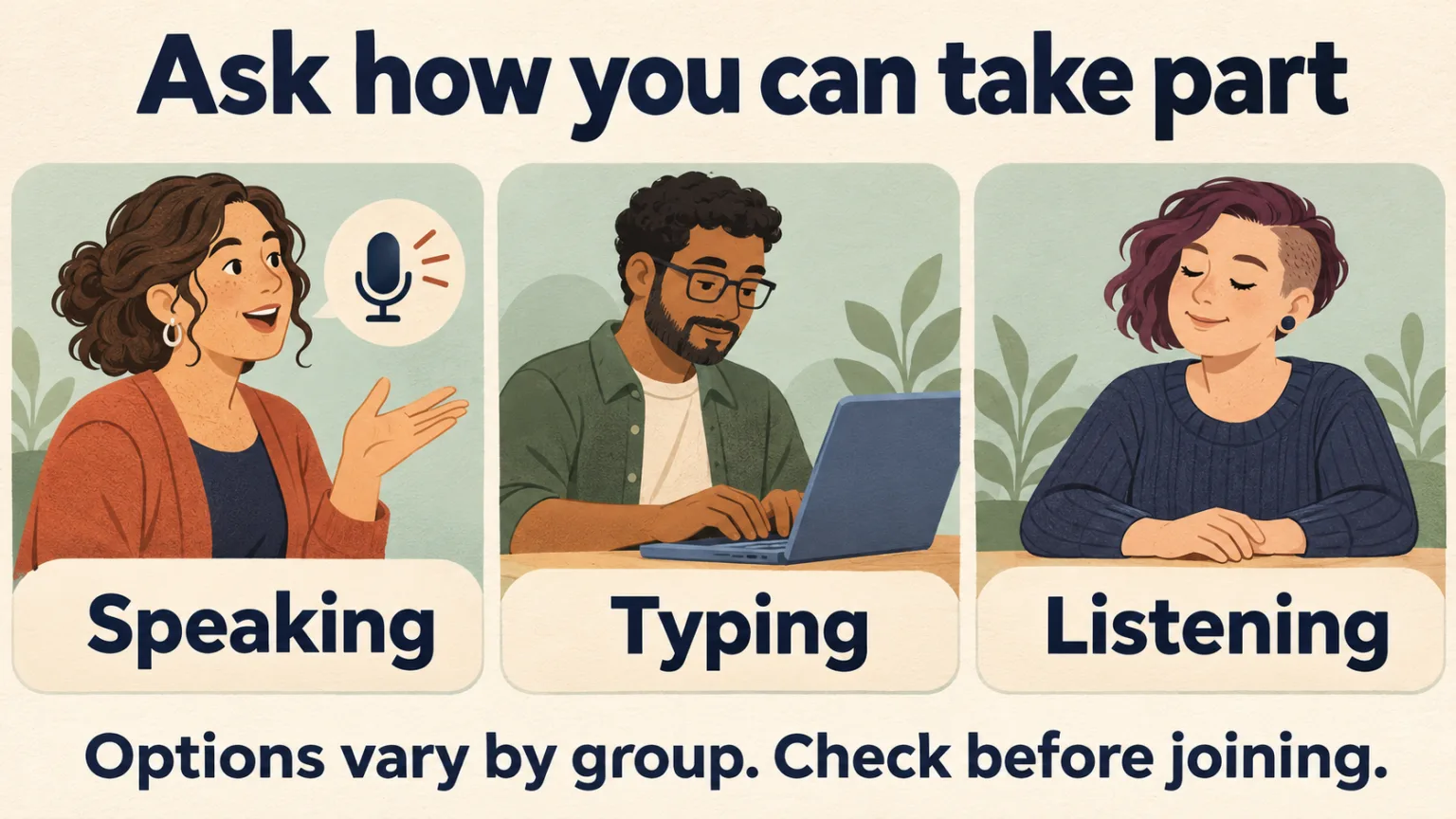
Can You Type, Listen, or Use AAC?
Ask about the form of communication you actually use. “Accessible” alone may not tell you whether the facilitator reads chat, allows time for an AAC response, or calls on every participant during introductions.
AAC means augmentative and alternative communication, such as a communication device or typed messages. If you need a support person, ask how they can assist while keeping your own choices central.
Checking how you can participate
You could ask
“I usually type my responses. Will someone follow the chat and give me time to finish? Can I listen without speaking at my first meeting?”
AANE’s participation guidance explicitly allows participants to be on or off camera and to stim during meetings. Other organizers may have different rules, so confirm what you need.
If typing is essential for you and the organizer has not confirmed whether someone reads the chat, ask again before paying for a series. You could request a short conversation with the facilitator or look for a group with a published participation policy.
Who Leads the Group, and What Are the Rules?
Ask who facilitates, how people take turns, and what happens if someone interrupts or makes another member uncomfortable. An autistic-led group may appeal to you; you can still ask about the facilitator’s experience and how concerns are handled.
Check a few practical details before committing:
- Session length, group size, time zone, fees, and cancellation or waiting-list rules.
- Whether a session is recorded, and the rules about screenshots and sharing someone else’s story.
- Whether members can contact each other privately, and how to decline contact.
- Who to contact if something goes wrong, including after the meeting.
A confidentiality rule sets an expectation; it cannot guarantee what every participant will do. Share only the identifying details you are comfortable giving to the group.
What to Expect at Your First Autism Support Group
Ask for the Plan Beforehand
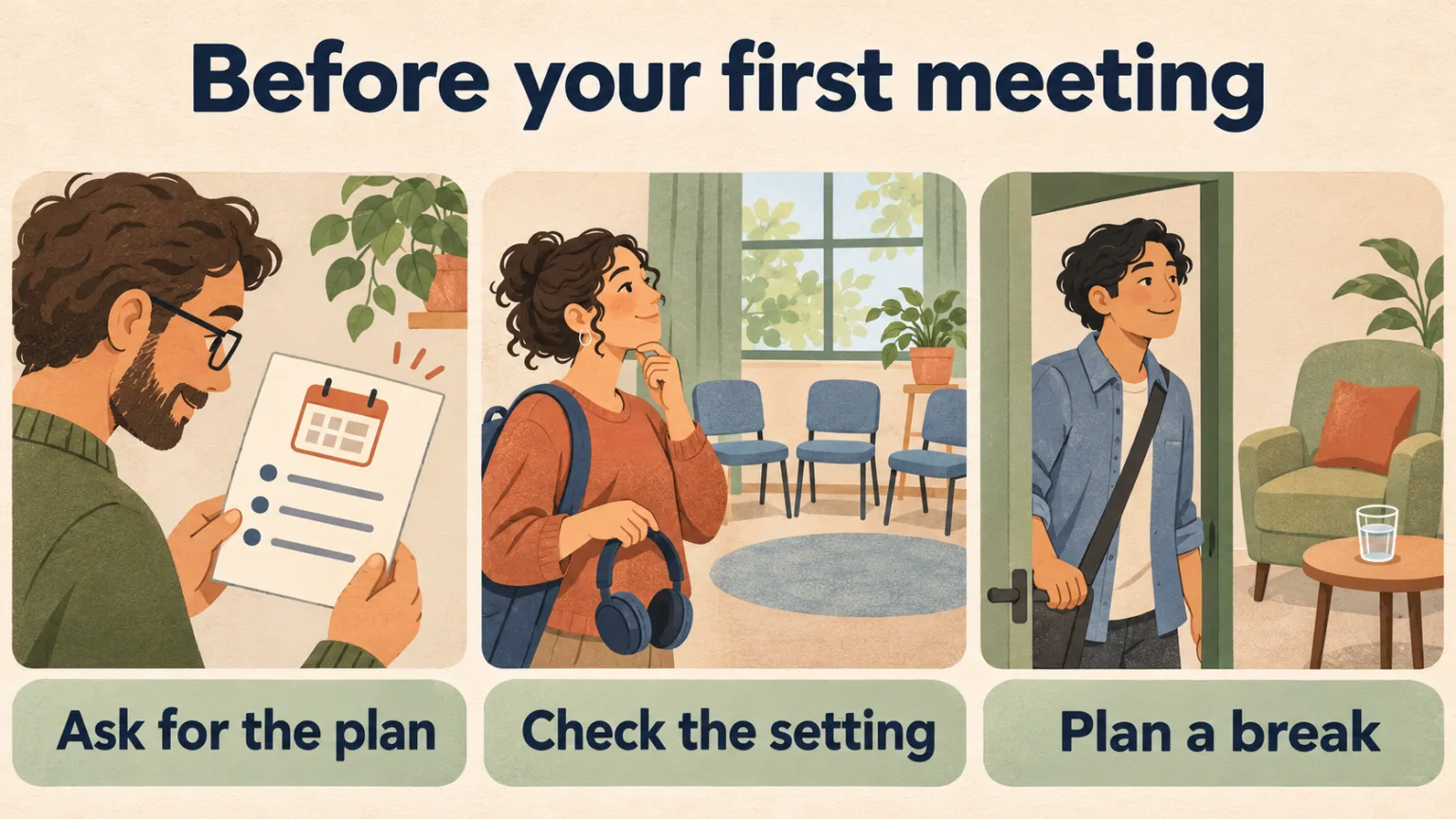
Knowing whether there will be introductions, a set discussion topic, or smaller breakout groups can help you decide how to participate. Ask for the outline and the facilitator’s name. For an in-person meeting, a photo of the entrance or room may help with finding your way.
In interviews with 12 adults about support after an autism diagnosis, participants described barriers to accessing groups. One participant put the difficulty this way:
“It is just ironic, there is support there, but in order to access it you have to do the thing that is really difficult.”
Requesting a preview of the session
You could ask
“Could you send me a short outline of the meeting? Will there be introductions or breakout rooms? Could I meet the facilitator briefly before the session?”
Plan for Sound, Screens, and Breaks
For an in-person group, ask about lighting, background music, seating, and somewhere to step away. Choose the details that affect you. You may prefer a lively activity over a quiet discussion circle.
Online groups remove the journey, but screens and overlapping voices can still take effort. A 2023 evaluation involving 16 adults in an online autistic-led program found mixed experiences. Participants appreciated aspects of attending from home, while technology and unpredictable breakout discussions caused difficulties for some.
Check the joining link and sound settings beforehand if that helps. Ask about captions, breaks, or hiding your own video. Availability depends on the platform and organizer.
When you need to step away
You could say or type
“I need a break from the sound. I’m stepping away now and will decide whether to rejoin.”
Choose What You Want to Share
If introductions are part of the meeting, prepare a short one. Your name and what brought you there may be enough. You can ask to pass on a question without giving your diagnosis history or explaining a difficult experience.
When you want to listen before sharing
You could say
“I’m new and would like to listen today. I’d prefer to pass on introductions beyond my name.”
If you lose your place after being interrupted, ask the facilitator for help. You do not have to turn the moment into a debate about your communication.
When you need time to finish
You could say or type
“I haven’t finished my thought. Could I have a moment to complete it before we move on?”
How to Tell Whether the Group Works for You
Give yourself time after the meeting to notice what worked and what took effort. You might enjoy the people and struggle with the room, or like the topic but find the pace too fast. Those differences help you decide what to ask for next.
- Could you finish a response, including through typing or AAC?
- Could you decline a question, stim, or take an agreed break without being singled out?
- Did the conversation relate to something you wanted support with?
- Did the facilitator respond when someone interrupted or crossed a boundary?
- Did the time and recovery afterward feel manageable for you?
You may want to try again with one adjustment. You can also decide that a group is unsuitable after one visit. There is no required number of meetings, new friends, or spoken contributions that makes attendance count.
Requesting a specific change
You could write
“I’d like to return, but I found it hard to join the discussion when several people spoke at once. Could you help with taking turns next time?”
If the group repeatedly dismisses your needs or pressures you to share, you can leave and contact the organizer separately if you want to. You do not owe other members continued attendance or private contact.
If You Need a Different Kind of Connection
If support discussions leave you with too much to process, autism social groups built around an activity may be a better fit. Look for something you would enjoy doing, such as drawing or playing a familiar game. You can also try a different age range or identity group.
For conversation around an interest, you could try a chatroom about a game or an art project. NDFriends lets you create or join chatrooms for free. If you want space to talk about the day, a topic such as “After-work reset: share one thing that helped today” tells people what the conversation is for.
If you create a room, put your expectations into your first message. Suggest that members ask before offering advice and avoid sharing other people’s posts outside the conversation. Ask what kind of response someone wants when they describe a hard day.
Asking for the kind of support you want in a chatroom
You could post
“The noise at work was a lot today. Is anyone up for listening? I’m not looking for suggestions right now.”
People can offer company and share what has helped them, while setting limits on their own availability. A member-created chatroom does not provide the same service as a facilitated support program or clinical care. Check the room’s expectations and share at your own pace.
For continuing a connection with one person, our guide to making friends as an autistic adult includes invitations and messages for staying in touch.
When you care but have limited energy
You could say
“I can listen for a few minutes, but I don’t have the energy for a longer conversation tonight.”
Questions About Autism Support Groups for Adults
Can I join an autism support group without a diagnosis?
Some adult autism groups welcome self-identified people and those exploring whether they are autistic. AANE’s community policy and Autism On the Go’s group rules explicitly say a medical diagnosis is not required. Other groups have different requirements. Ask the organizer what you need to provide before registering.
Are there free autism support groups for adults?
Yes. Examples include Autism On the Go’s online groups, Scottish Autism’s network for adults living in Scotland, and Autism Edmonton’s adult discussion group. AANE also offers free Community Connections introduction sessions and some free groups. Age, location, and registration rules vary; check the resource table and the organizer’s page.
Do I have to speak or turn my camera on?
That depends on the group. Some explicitly allow listening, typed participation, or cameras off; others have different formats. Ask whether your preferred way of communicating will be supported, including time to finish typed or AAC responses.
How can I find an adult autism support group near me?
Use the Autism Society affiliate directory in the US, the National Autistic Society branch finder in the UK, or Autism Junction in Canada. In Australia, Autism Connect can help you find local options. Select adult services where filters are available, then confirm the group’s audience, residency rules, venue, and current meeting details.
What if an online group leaves me exhausted?
Notice what took effort: several voices, watching faces, a long session, or switching into breakout rooms. Ask whether one of those conditions can change. A shorter session, another format, or an activity group may work better. You can stop attending a group that costs more energy than you want to give it.